Context
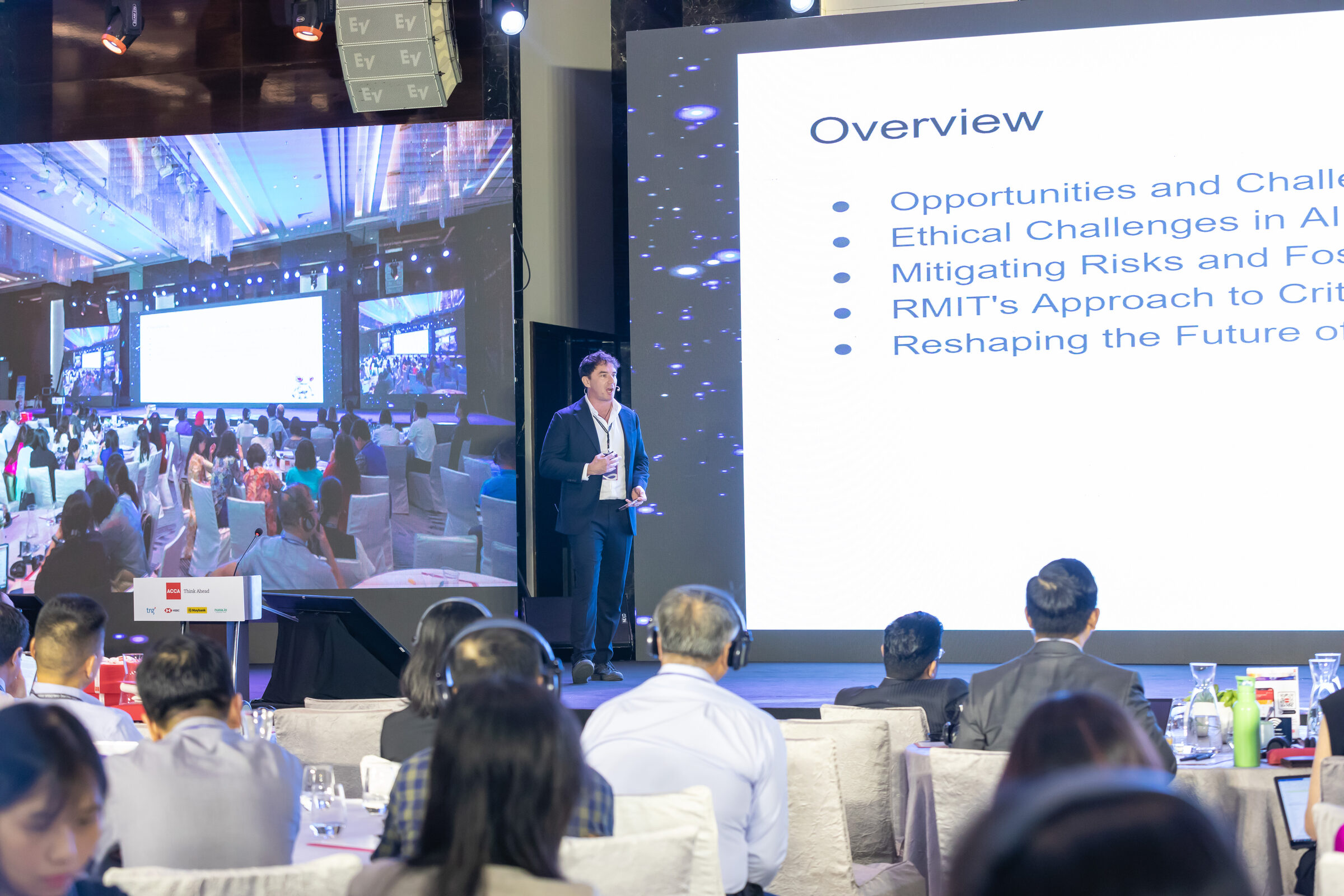
The 2024 ACCA Asia Pacific Dialogue brought together over 700 attendees from 15 countries and 18 sectors under the theme “Weaving the Fabric of Tomorrow’s Success Together” — C-suite executives, policymakers, accountants and higher education professionals addressing digital transformation, sustainability and the future of the finance profession across the region.
I was invited to present on the sustainable and ethical application of generative AI — a brief that required translating a framework developed in higher education for an audience whose professional world is defined by fiduciary responsibility, regulatory compliance and cross-border accountability.
The challenge
The design problem was balance. Finance and professional services audiences arrive at AI conversations with legitimate enthusiasm for efficiency gains — and legitimate exposure to the risks that enthusiasm can obscure. Copyright liability, data privacy, algorithmic bias and the environmental cost of AI infrastructure are not abstract concerns for a room of accountants and executives. They are governance questions with material consequences.
The session needed to honour the genuine excitement in the room without letting it crowd out the accountability questions the profession cannot afford to ignore.
The approach
The session opened by validating what the room already knew: AI capability is genuinely extraordinary. That validation was not rhetorical courtesy — it was the precondition for what followed: five accountability dimensions the finance profession is structurally positioned to take seriously.
Copyright. Models trained on content drawn from the internet, generating responses without citation — with the New York Times litigation and the OpenAI voice-rights dispute used to make the liability landscape concrete rather than theoretical.
Bias. AI as a product of its training data — skewed by culture, language and historical perspective, with direct implications for any organisation using AI to support decisions affecting people.
Sustainability. The infrastructure behind AI consumes water and energy at scale — by estimates presented at the time, training GPT-4 alone required six billion litres of water for cooling. For organisations with sustainability commitments, AI adoption is not environmentally neutral.
Privacy. Interaction data captured by default, with significant implications for client confidentiality and fiduciary duty.
Truth. Synthetic media — fast and easy to produce, already causing serious harm. For a profession built on the integrity of financial information, the erosion of evidentiary trust is not peripheral.
The session closed with practical frameworks for navigating these dimensions — not as constraints on adoption, but as the conditions under which adoption becomes defensible.
Reception
ACCA published an extended account of the session in their official event report. Among the positions they published was one the profession needed to hear directly: that sophisticated AI use cannot be reliably detected, and that governance built on detection is governance built on sand.
ACCA subsequently featured the session in their “Voices from the ACCA APAC Dialogue” video series.
What this demonstrates
A finance and professional services audience is not a forgiving room for abstraction or false optimism. That this audience received a framework built in higher education, found it immediately applicable, and that ACCA chose to publish and amplify the contribution in their own materials, is evidence of something specific: the governance argument travels — across sectors, and across the professional registers that define them.
The accountability questions are the same. The speed differential is the same. The gap between adoption and governance is the same. The room in Hanoi confirmed it.